
 Founders often use “incubator” and “accelerator” interchangeably, and honestly, it’s an easy mix-up – both offer mentorship, both connect you to funding, and both are meant to help early-stage companies grow. But the two are built for different moments in a startup’s life, and picking the wrong one can cost a founder months they didn’t need to lose.
Here’s a clear breakdown of how they differ, and how to figure out which one actually fits where your startup is right now – using the range of programs run by Amrita Technology Business Incubator (Amrita TBI) as a real-world reference point, since it happens to run both models under one roof.
The Core Difference: Time Horizon and Starting Point
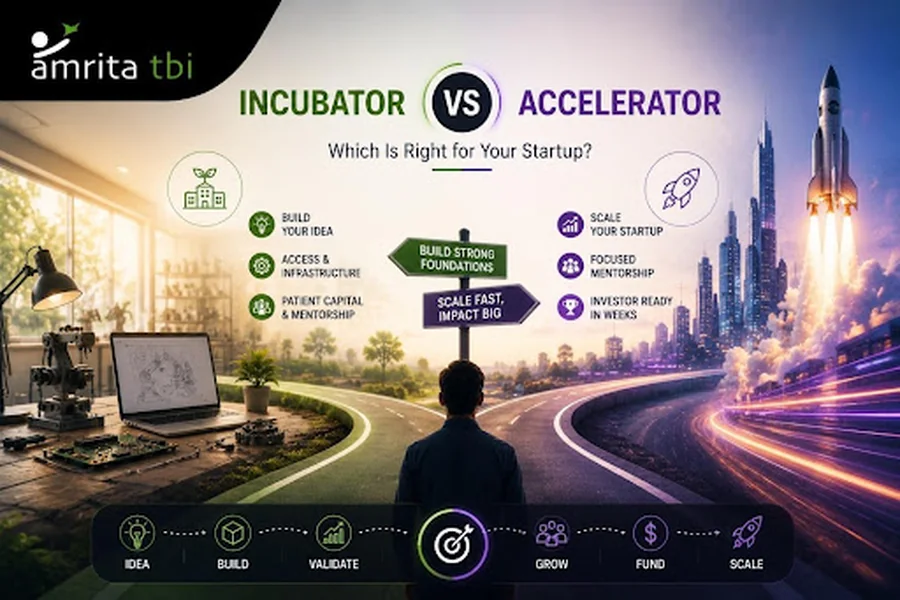
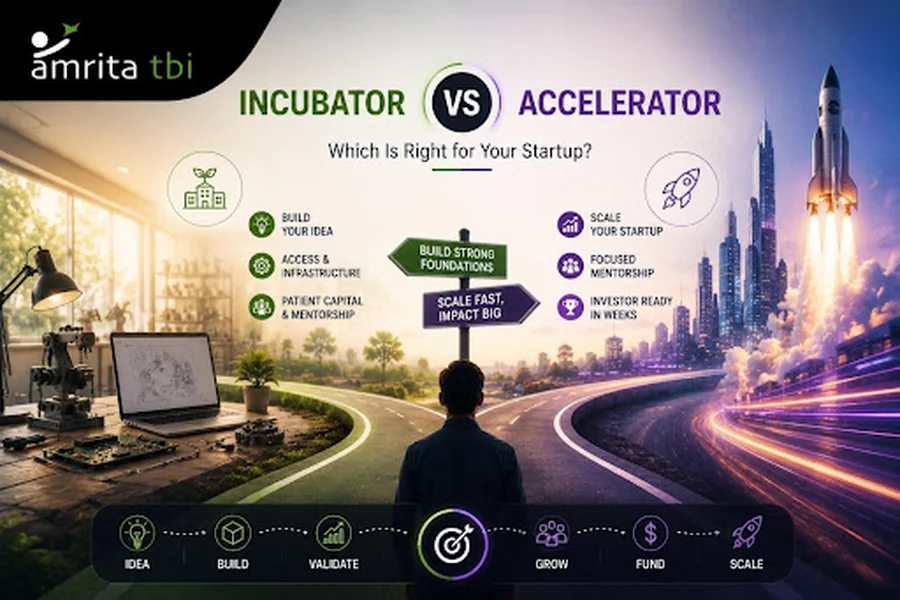
The simplest way to separate the two is this: incubators are for building, accelerators are for sprinting.
An incubator assumes you might not have a finished product yet -you can be at an idea stage, or an early prototype – and gives you time, space, and infrastructure to work through the fundamentals: what the product should be, who it’s for, and how the business actually holds together. A startup can stay incubated for a longer stretch i.e for a period of 2 to 3 years subject to approval from the incubator
An accelerator assumes the opposite: you already have something working – a product, some early users, maybe modest revenue – and what you need isn’t more time to build, it’s a compressed, intense push to get investor-ready fast. Accelerators run in fixed cohorts, usually a few months long, and end in a specific moment: a Demo Day in front of investors.
Amrita TBI’s own programs map cleanly onto this distinction. Its core Incubation program is built for startups “in idea stages and growth stages,” offering physical and virtual space, lab access, and up to INR 1 crore in funding channeled through government schemes – with no pressuring founders toward an exit event. Its Accelerator, by contrast, is described as “a fast paced program” that pushes startups through idea validation, business model refinement, and go-to-market strategy, culminating in a Demo Day where startups pitch to external investors and can access Amrita TBI’s own $100,000 seed pool for the top three teams.
What Incubation Actually Gives You
If you’re at the idea or early-build stage, an incubator’s value is mostly about removing the obstacles that make building hard in the first place:
1.Space – Amrita TBI offers physical co-working across Kollam, Bengaluru, and Coimbatore, or fully virtual incubation for founders anywhere in India
2. Infrastructure – access to over 100 multidisciplinary labs and a dedicated Fab Lab for prototyping (3D printing, PCB design, CNC machining), which matters enormously if you’re building anything hardware-related
3. Patient capital – funding structured around building rather than scaling, up to INR 1 crore through a mix of loans and equity
4. Reduced overhead – a three-year GST exemption on revenue up to INR 50 lakh, discounted AWS credits and partner services, and an internship pool to draw from
5. Long-horizon mentorship – ongoing relationships with mentors, not a single scheduled session
The tradeoff is pace. Incubation doesn’t force you toward a specific outcome by a specific date. That’s a feature if you genuinely need the time; it can be a drawback if you already have traction and just need momentum.
What Acceleration Actually Gives You
If you already have a working product and some early signal that it resonates, an accelerator’s value is compression – taking things you’d otherwise take a year to figure out and forcing them into a few intense months:
1.Structured sprints – business model refinement, customer development, and go-to-market strategy, worked through in a defined cohort
2. High-caliber mentor access – Amrita TBI’s Accelerator specifically brings in mentors who’ve been executives at Fortune 500 companies or built their own startups with global reach, from both India and Silicon Valley
3. A funding event, not just funding – the program culminates in a Demo Day where startups pitch to external investors, with Amrita TBI itself committing $100,000 across the top three startups
4. A clear finish line – the explicit goal is to be “fundable-ready by Demo-Day,” which gives founders a forcing function that incubation, by design, doesn’t provide
The tradeoff here is readiness. If your product isn’t validated yet, an accelerator’s compressed timeline can push you toward decisions before you actually have the information to make them well.
A Quick Way to Decide
Ask yourself these questions:
Do you have a working product with real users, even if early? If no – lean incubator. You need time and infrastructure, not a sprint. If yes – an accelerator becomes a real option.
Is your biggest constraint infrastructure (lab access, prototyping space) or momentum (getting investor-ready fast)? Infrastructure constraints point to incubation. Momentum constraints point to acceleration.
Are you building something hardware-heavy or deep-tech? These often need incubation-style patience and lab access before they’re anywhere near accelerator-ready – which is part of why Amrita TBI also runs a dedicated PRAYAS program specifically for hardware prototyping, alongside its main Incubation track.
Do you need a fixed deadline to force decisions, or do you need room to iterate without a clock running? Accelerators create urgency by design. Incubators remove it by design.
Neither is better – it depends on what your startup actually needs right now.
Why Some Founders Need Both, in Sequence
The more useful way to think about this isn’t “incubator or accelerator” as a permanent choice – it’s a sequence. A startup often benefits from incubation first, to get to a validated product and early traction, and acceleration second, once there’s something real to compress and sell to investors.
This is exactly why ecosystems like Amrita TBI’s are structured the way they are: Incubation to build the foundation, PRAYAS or NIDHI-EIR to support very early or hardware-specific ideas, PitchFest to get in front of investors once there’s something to show, and the Accelerator to push a company that already has traction into a fundable, investor-ready state. Founders don’t have to guess which single program to commit to forever – they can move through the stack as the business itself matures.
The Bottom Line
Incubators and accelerators solve different problems. Incubation is about giving an idea the time, space, and infrastructure to become a real, validated business. Acceleration is about taking a business that already works and compressing the path to being fundable. Neither one is a shortcut around the other – the right choice depends entirely on which problem your startup actually has right now. For founders in India weighing this decision, it’s worth looking for an ecosystem, like Amrita TBI’s, that offers both under one roof – so the choice isn’t permanent, and the startup can move to the next stage of support exactly when it’s ready.
Amrita TBI runs both Incubation and Accelerator programs, alongside PitchFest, PRAYAS, and NIDHI-EIR, from campuses in Kollam, Bengaluru, and Coimbatore. Program details are available at amritatbi.com.